109. JOY IN MOTION
June 18, 2026
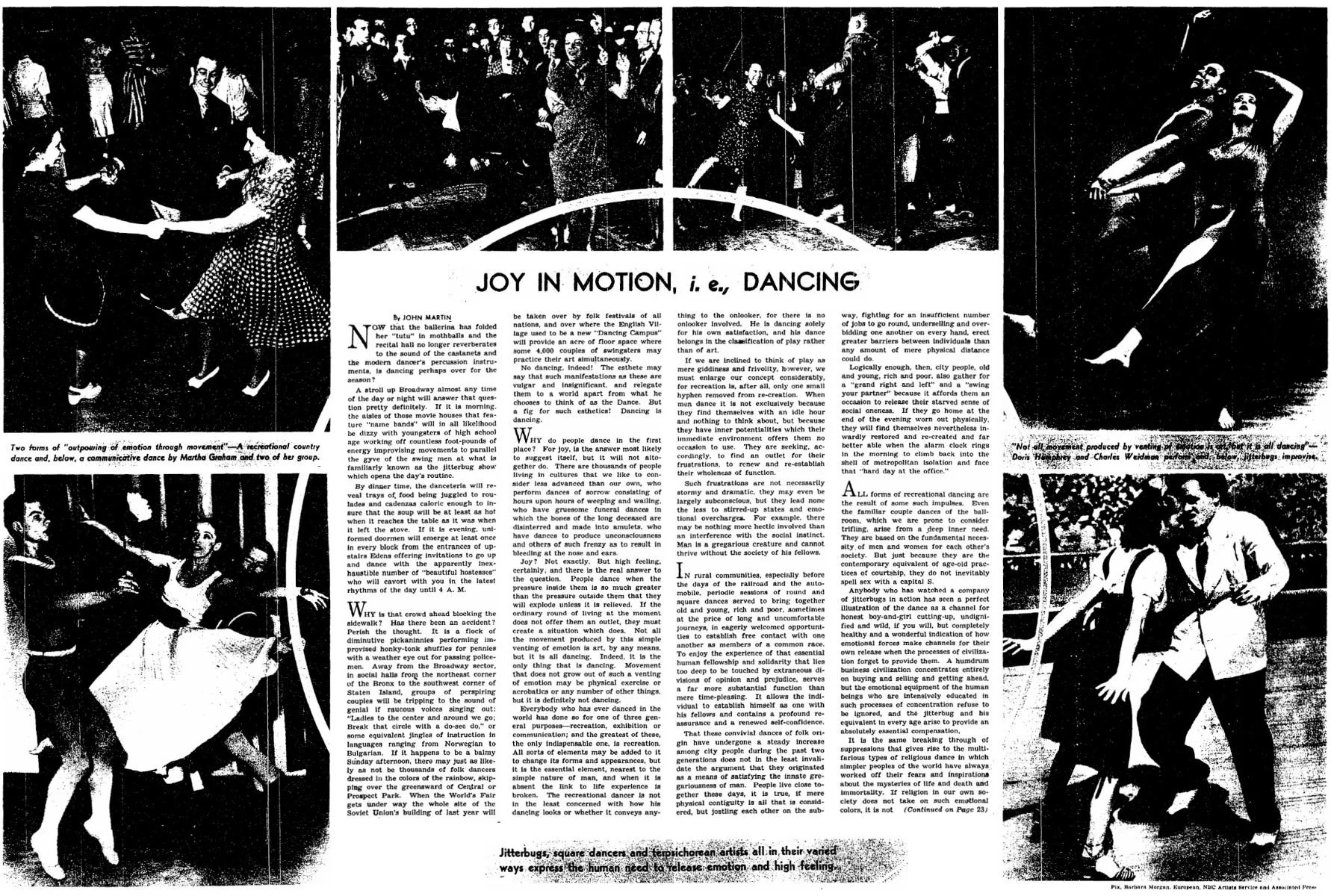
From the TimesMachine:
The dance as a communicative art also maintains its roots in this simple soil or else dries up and dies. Where the exhibition dancer concerns himself with the outward half of the recreational dance, the communicative dancer lays his emphasis on the inward half, the half that has to do with content. The former presents its brilliance and virtuosity, while the latter deals with the subjective and intangible elements of its emotional impulses, with those things that are still below the level of intellectualization.
Because our nervous systems are so constituted that we respond to all experience first in terms of movement, the dance is automatically the medium which is first involved in the expression of those feelings and those concepts that we cannot reduce to simple statements of fact. This kind of eloquent outpouring of emotion through movement has present for countless centuries in the dances of primitive people, but it was not until Isadora Duncan captured its essence some forty years ago that it became a part of the world of art. She found that she could in a sense take the place of the priest of shaman or the primitive tribes in her own day by giving expression to human passions common to all men in such an eloquent, if unintellectualized, way that those who watched her would be infused with her conviction and share her emotional release.
(Source/Image: Martin, John. 1940. “Joy in Motion.” The New York Times. May 19.)